
Understanding the Review page
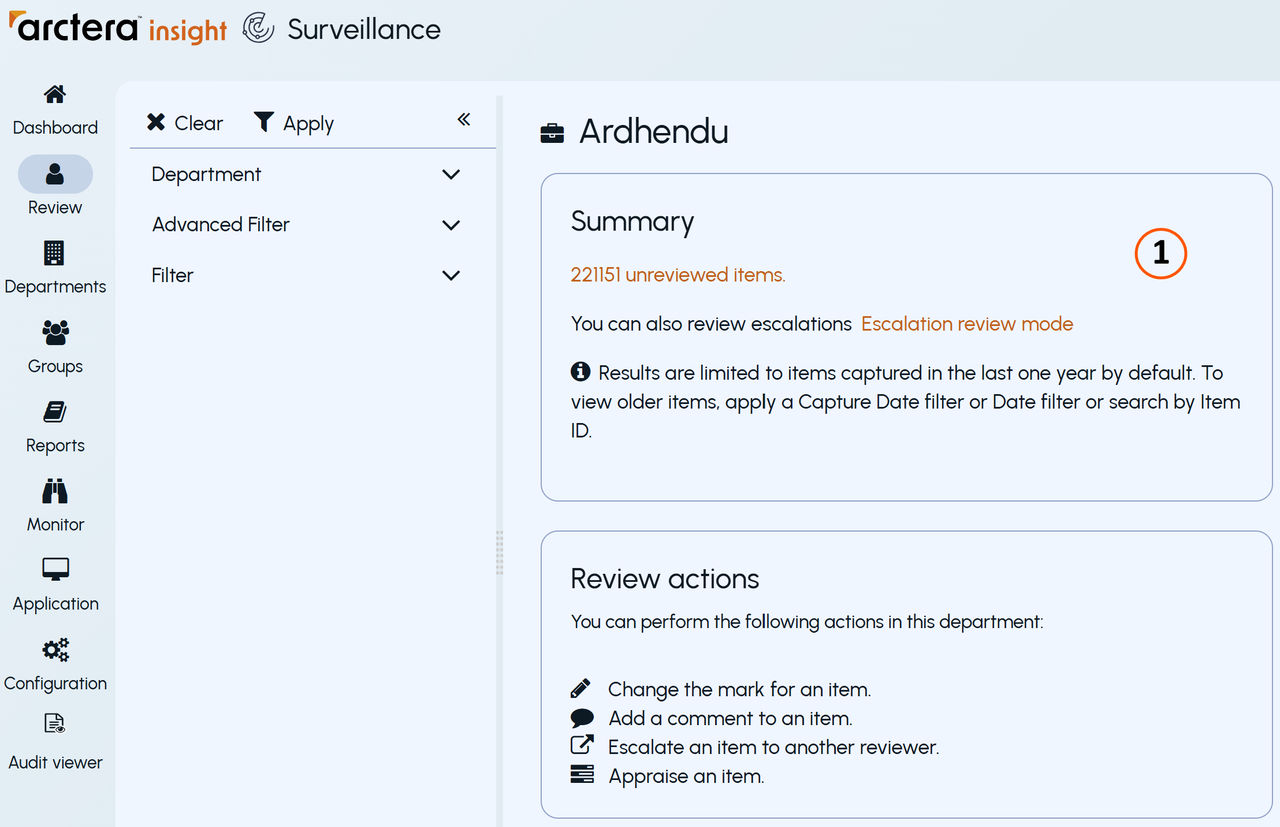
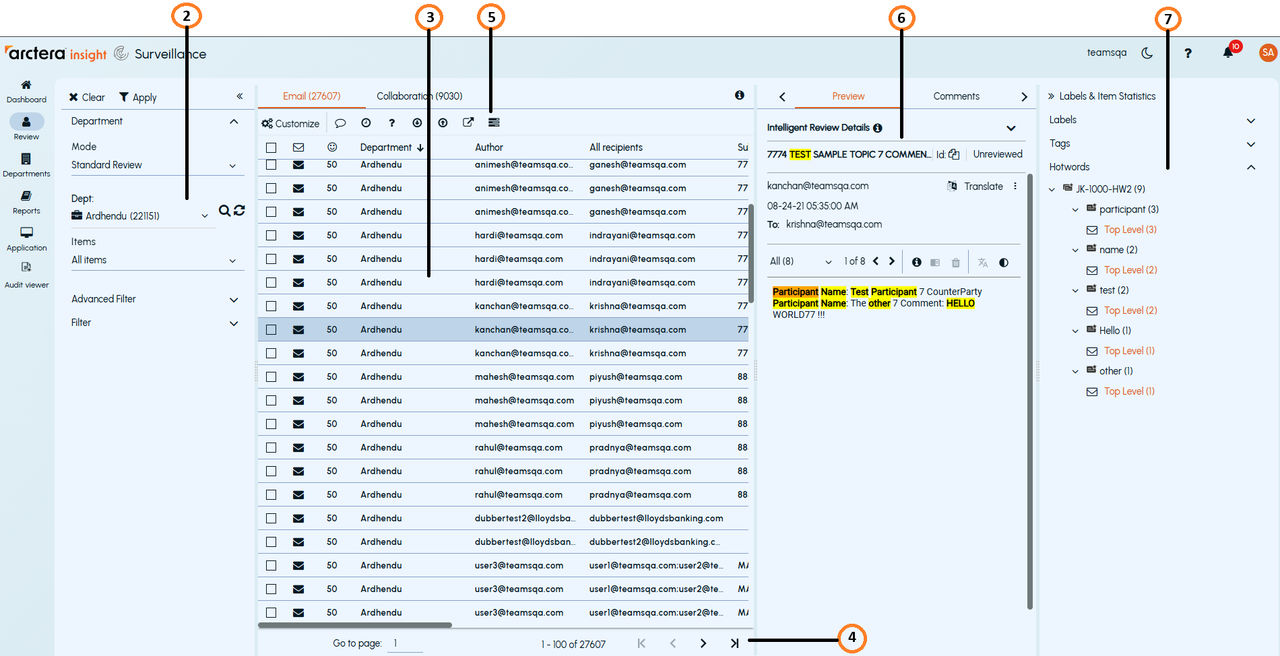
The following image highlights the standard features of the Review page.
Figure: A sample page showing review summary of selected departments
 |
|---|
Figure: A sample page showing other panes with details
 |
|---|
1\. Summary and instruction pane
This page displays the summarized information of review items. You can click the summary items to view the details.
2\. Filter pane
Insight Surveillance lists only those departments for which the reviewers have access. Reviewers can use the filter facets to set criteria to refine the search records. You can collapse this pane for better readability as and when required.
3\. Review item grid
This grid shows the items in the review set that match the filter options you have selected. You can use the Group drop-down list to group or sort the items according to relevance, ascending or descending dates and months, alphabetical author and subject names, and tags. The unreviewed items are displayed in bold text.
Click on the column heading to sort items in ascending or descending order. The changes are persisted across different login sessions for the logged-in user.
4\. Footer area
This area provides the navigation arrows at the bottom of the items grid to go to the first, previous, next, or last page.
5\. Action bar
The action bar lets you perform the following actions:
-
Apply review statuses and add comments to single or multiple selected items.
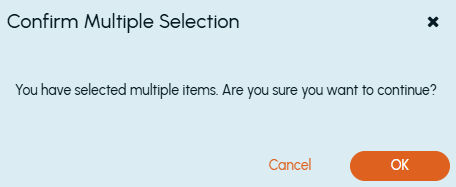
When applying a review status to a single item, the application does not prompt to confirm the selection of the item. However, while applying a review status to multiple items, the application prompts a confirmation to ensure accurate selection and avoid errors, as shown in the sample image below.
 |
|---|
-
Rearrange the column order for improved review experience. See Rearranging columns in the item list pane.
-
Change the position of the reading pane (Preview, Comments, and History) to right or bottom of item list pane. See Changing the Preview pane position.
6\. Reading pane
This pane has three tabs and two functions.
-
The Preview tab displays an HTML preview of the selected item.
In addition, it provides the following interfaces:
-
The Intelligent Review Details section provides the facts of why the item is classified as Unreviewed RelevantorUnreviewed Irrelevant. The application shows the Relevant and Irrelevant labels (links) and the respective contributions.
-
The Learning bar lets you select the text samples for the intelligent review process. You can add or remove the selected text samples from the item being reviewed.
-
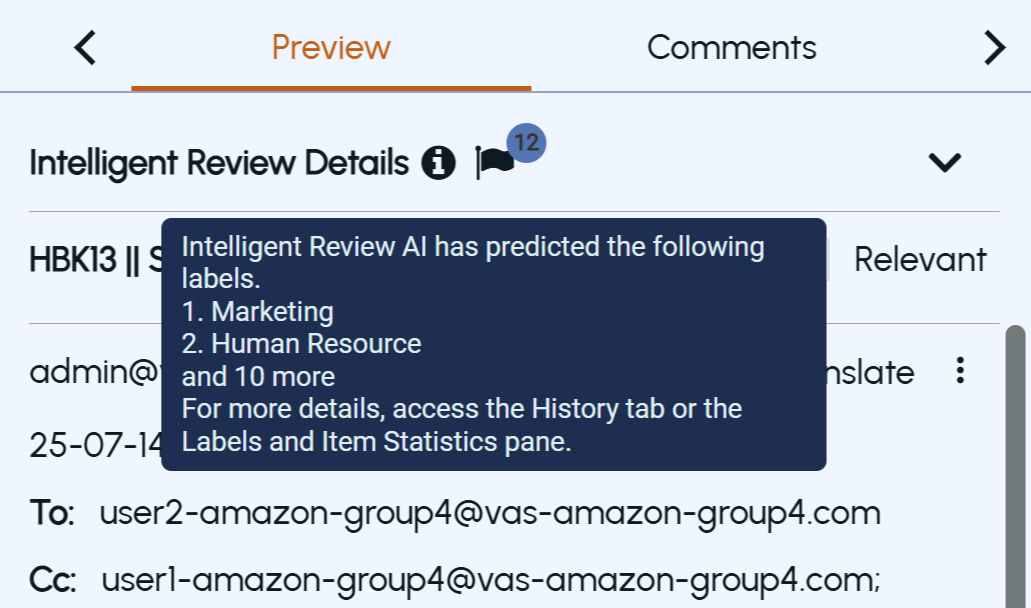
The flag icon, representing AI-based Label Predictions, shows AI-predicted labels and their count for each review item if the Enable AI Predictions option is selected for active labels and label groups. Refer to the sample image below.
-
The Display Name of the email author and recipients are displayed along with their email IDs. If a tag is applied to the author or recipient email IDs, the application highlights these display names and considered for tag statistics calculations.
-
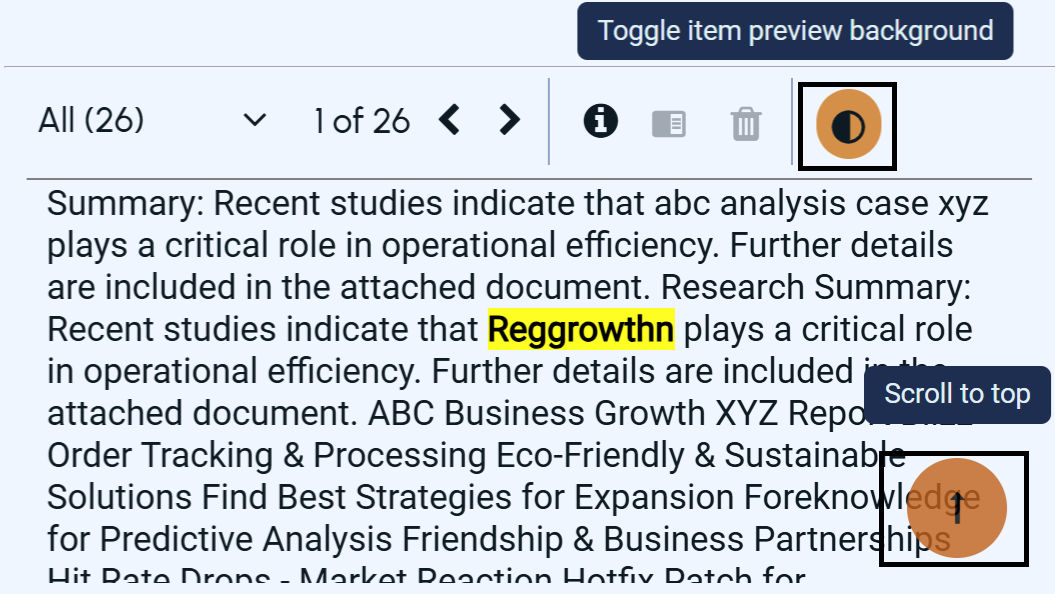
The Toggle Item Preview Background icon enhances text readability by allowing to highlight or remove highlighting from the preview text. Refer to the sample image below.
-
The Scroll to Top icon allows users to quickly return to the top of the preview pane, especially when viewing lengthy paragraphs of text.
-
The Comments tab shows the comments that reviewers have assigned to the selected item.
-
The History tab displays the detailed summary of the operations that are performed on the selected item.
-
The Kebab icon (three vertical dots) provides the Print option to view the printable version of the item, and the Download option to save the printed file to your computer.
7\. Labels & Item Statistics
This pane has the following sections:
-
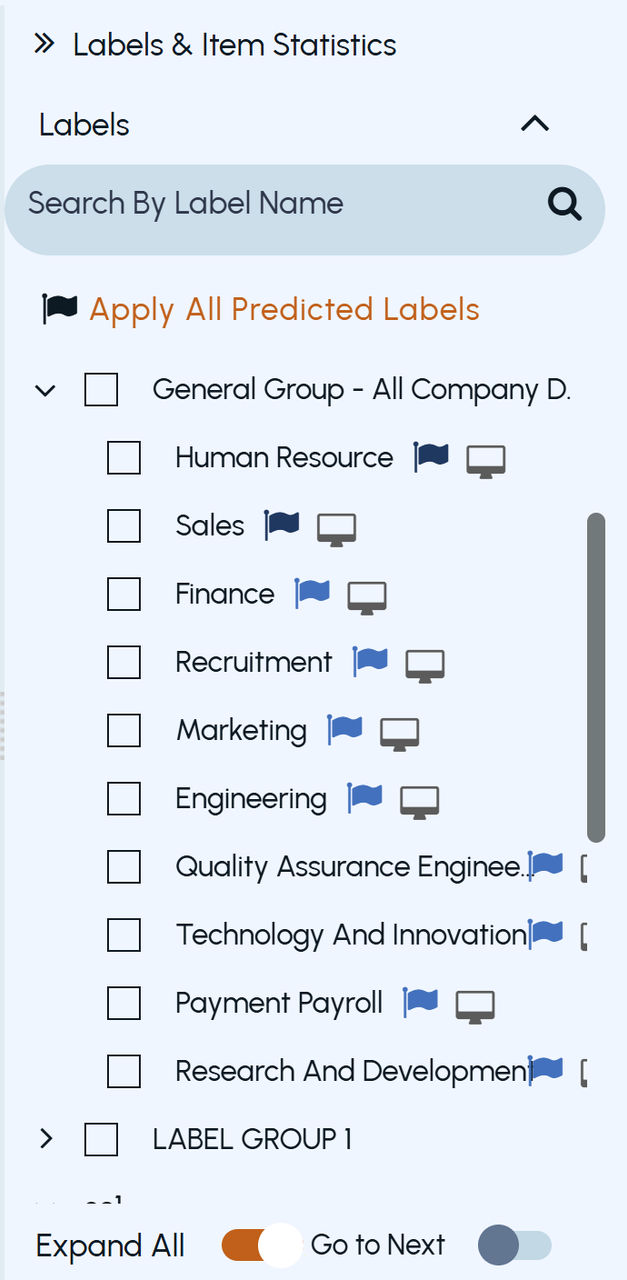
Labels: This section displays active labels, labels within label groups, and labels within single-choice label groups. You can visually distinguish between application-specific, department-specific, and AI-predicted labels.
AI-predicted labels are marked with a flag icon. Flag icon color varies with prediction confidence.
Application-specific labels are marked with a monitoring screen icon, while the Department-specific labels lack an icon. Refer to the sample image below.
 |
|---|
-
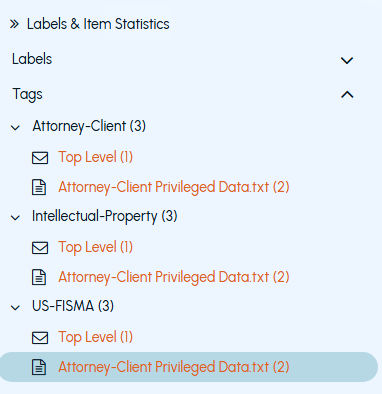
Tags: This section shows the classification policy tags-specific statistics when a user selects an email for review.
The displayed information includes tag names. Next to each entry, the number of incidents that match the corresponding tags in the selected items is shown. After you expand the tag name node, the application displays the number of matches in the top-level content of the email and in each attachment of the email.
 |
|---|
This section displays statistics only for the tags that have a match. Tags that do not match are not shown in the list.
The Top Level node and the attachments nodes are visible only if the content within them contains the specified tags. In case there are no matches for the tags in the primary emails, the Top Level node will not be displayed. Similarly, if there are no matches for the tags in the attachments, those attachments will also not be displayed.
You can click the hyperlinks to view the respective tags in the Preview pane. Click the arrows to navigate to the next or previous match. The navigation is limited to the content of email body message and attachments, and not within the email metadata.
-
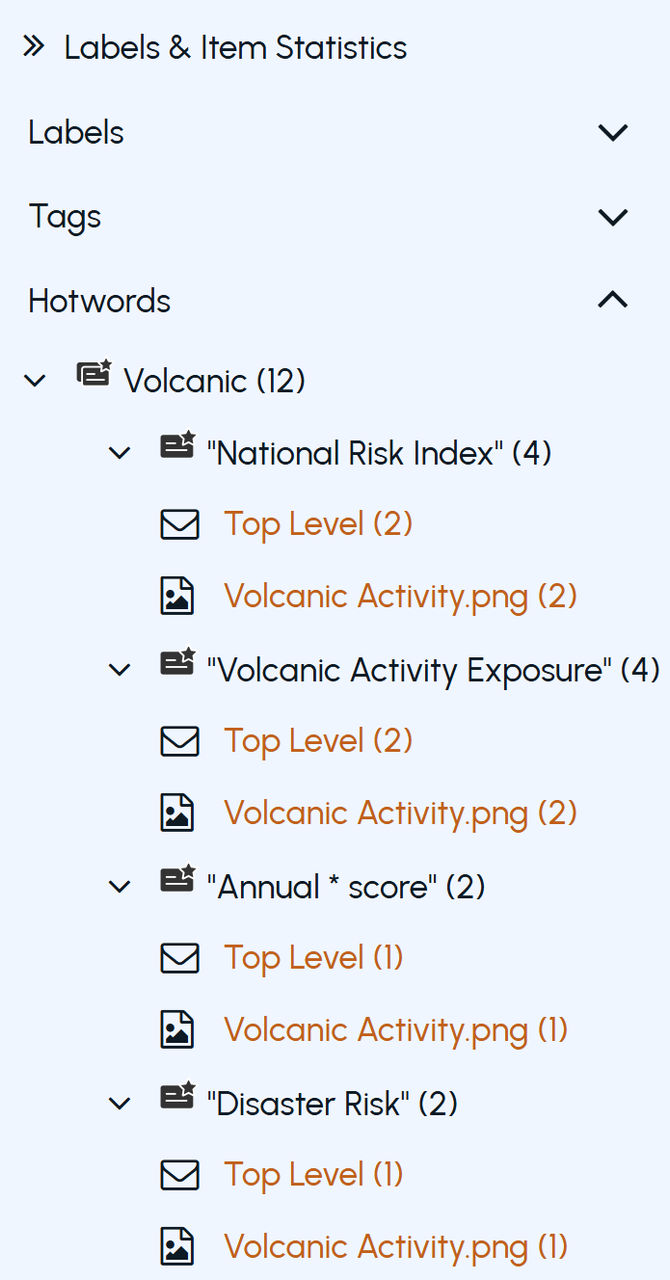
Hotwords: This section shows the hotwords-specific statistics when a user selects an item for review.
The displayed information includes the names of hotwords sets and individual hotwords. Next to each entry, the number of incidents that match the corresponding hotwords or hotwords sets in the selected items is shown. After you expand the hotwords set name, the application displays the included hotwords and their number of matches in the top-level content of the item and in each attachment of the item.
 |
|---|
This section displays statistics only for hotwords or hotword sets that have a match. Hotwords and hotword sets that do not match are not shown in the list.
The Top Level node and the attachments nodes are visible only if the content within them contains the specified hotwords. In case there are no matches for the hotwords in the primary emails, the Top Level node will not be displayed. Similarly, if there are no matches for the hotwords in the attachments, those attachments will also not be displayed.
You can click the hyperlinks to view the respective hotwords in the Preview pane. Click the arrows to navigate to the next or previous match. The navigation is limited to the content of email body message and attachments, and not within the email metadata.
Note: For audio-video items, hotword and tag statistics calculation is not supported for attachments.
More Information
Related information