
Enhanced Reporting - User Interface
Overview
Arctera Surveillance introduces UI-based Enhanced Reporting for creating, running, scheduling, and managing reports. In addition to the existing reporting APIs, this feature now allows users to generate and manage reports directly from the application without manually invoking APIs.
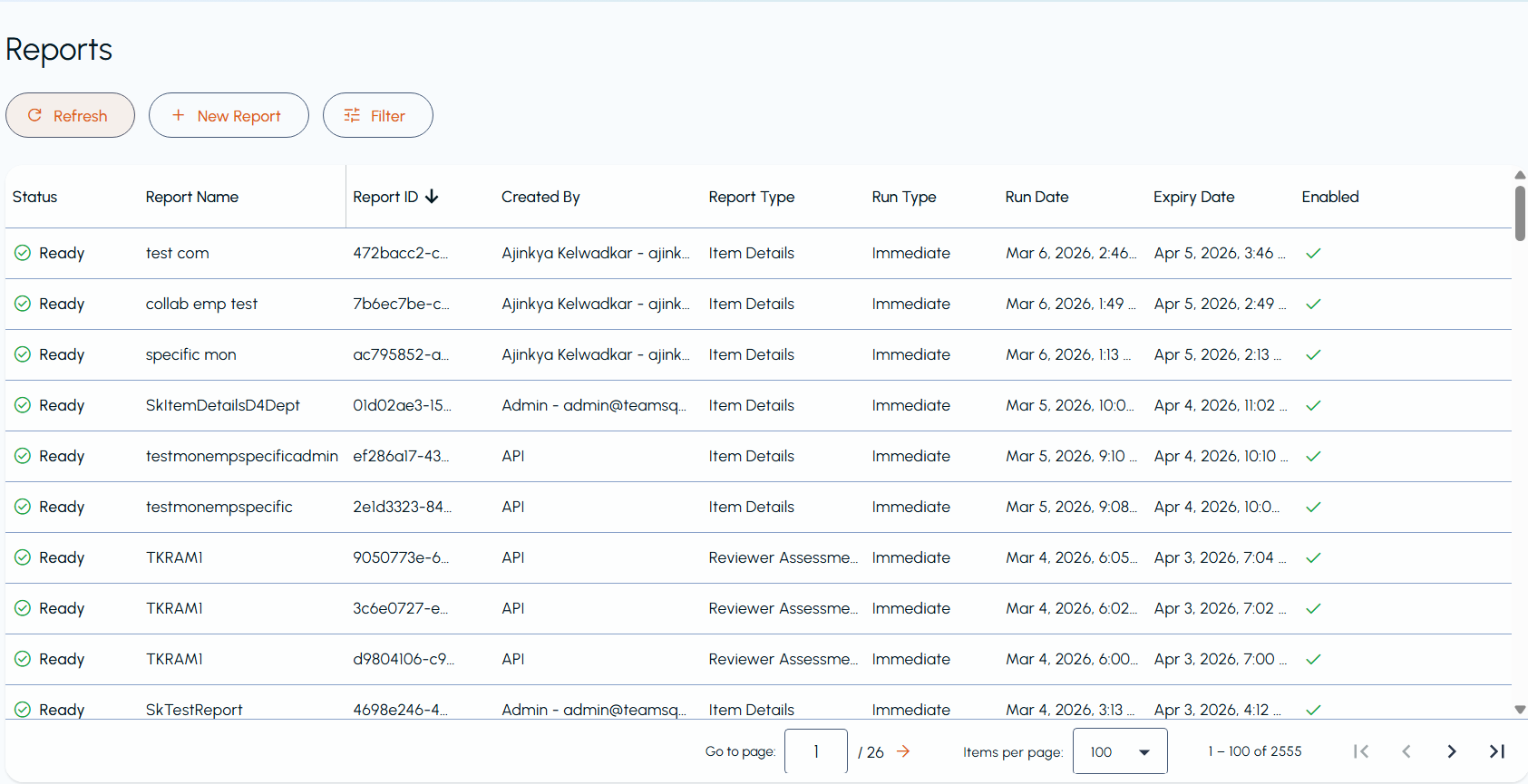
To access Enhanced Reporting - User Interface, click Enhanced Reporting option in the left navigation panel. The Enhanced Reporting interface opens in a new tab and displays a list of existing reports.
Currently, Arctera Surveillance supports report generation through the Enhanced Reporting user interface for the following report types:
-
Item Details
-
Item Metrics
-
Evidence of Review
-
Item Hotword Metrics
-
User Roles
-
Reviewer Assessment Activity Date
Note: For more information about all supported report types and their access methods, see Access Methods in About Arctera Surveillance reports.
Access and Permissions
Access to Enhanced Reporting user interface requires the Manage Enhanced Reports permission. It can be accessed through Application tab > Roles. The users with this permission can:
-
Access the Enhanced Reporting UI
-
View all departments available for reporting
-
Create and manage reports across departmentsNote: By default, this permission is enabled for certain predefined application roles (such as System Admin and App User Admin). For custom roles, administrators must enable it explicitly.
Report List View
The report list displays all reports created through:
-
User Interface (labeled using username), and
-
Reporting APIs (labeled as API)
Note that for legacy reports created through user interface in earlier releases, the label displays 'User' instead of the actual username. This distinction helps users identify how a report was created, especially when reports are consumed by external tools such as Power BI or Tableau.
Each report entry includes details such as:
-
Status
-
Report name
-
Report ID (can be copied for sharing)
-
Created by (User or API)
-
Report type
-
Run type (Immediate or Schedule)
-
Run date
-
Expiry date
-
Enabled
Action buttons (Requeue, Edit, View Runs, and Download) appear on hover only for reports created through the user interface. No action buttons are displayed for API-generated reports.
Note: Once a report has expired (after its expiry date), the Download button is no longer available.
A Refresh option allows users to reload the report list to view the latest status updates.
Filtering the Reports
When a large number of reports exist, users can narrow down the list using available filters, including:
-
Report name
-
Report typeThe following report types are available for filtering:
-
Item Details
-
Item Metrics
-
Item Metrics by Monitored Employee
-
Evidence of Review
-
Evidence of Review by Department
-
Item Archived Metrics
-
Item Classification Metrics
-
Item Hotword Metrics
-
Item Label Metrics
-
Item Label Metrics by Department
-
Reviewer Assessment
-
Reviewer Mapping
-
User Roles
-
Item List and Filter Summary
-
Reviewer Assessment Activity Date
Note: Although Enhanced Reporting - User Interface currently supports the generation of the following report types: Item Details, Item Metrics, Evidence of Review, Item Hotword Metrics, User Roles, and Reviewer Assessment Activity Date, the Report type filter also includes report types generated through other reporting methods, such as the API and Review pane. -
-
Report Enabled Status (All, Enabled, Disabled)
-
Run status (Queued, Processing, Ready, Failed, Retry Queued, Scheduled)
-
Run Start Date
-
Run End Date
-
Report ID
-
Run Type (Immediate, Schedule)
Run Types
Enhanced Reporting interface supports two run types:
-
Immediate Run
-
The report runs once, immediately after submission.
-
Only a single execution is created.
-
Run can be requeued or downloaded.
-
Requeue is not available for Item List and Filter Summary reports generated before the July 2026 release.
-
-
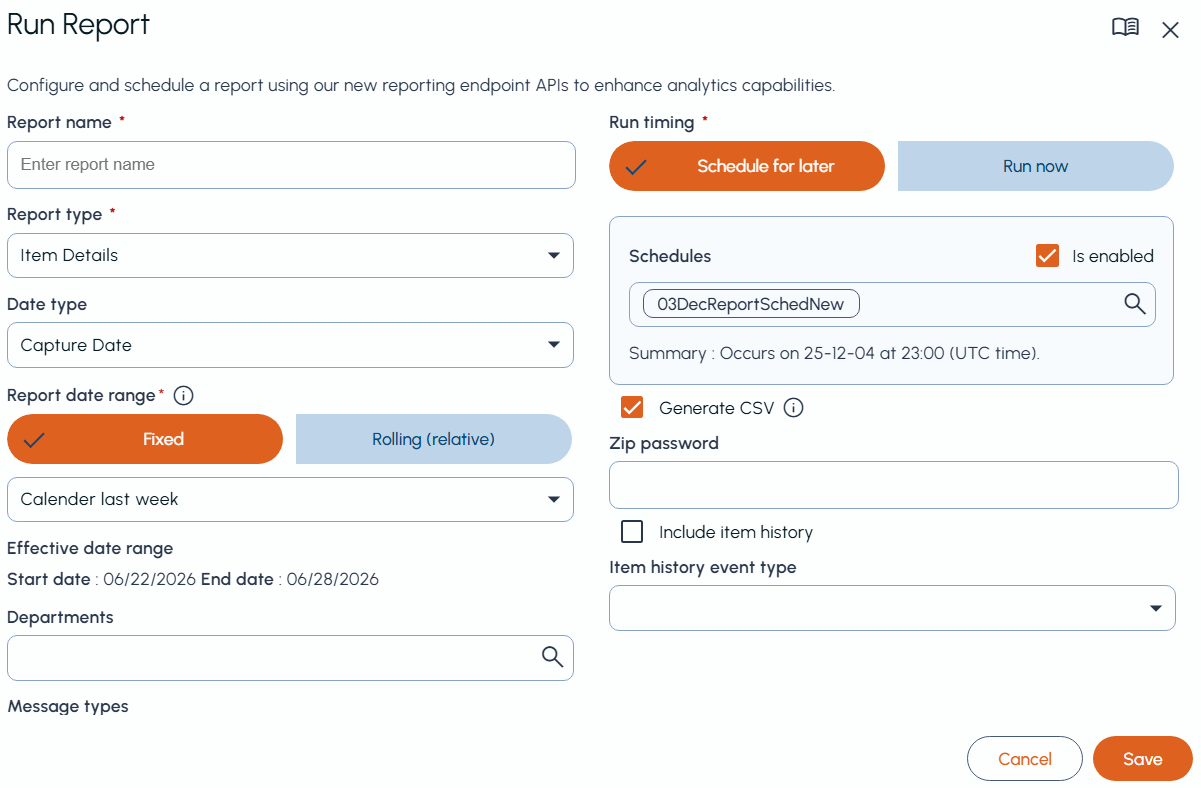
Schedule Run
-
The report runs automatically based on an existing report-specific schedule.
-
Schedules must be created in advance under Configuration > Schedules > New Schedule > Scheduled for: Report.
-
When scheduling for a report, user can opt for:
-
Daily or weekly execution
-
Hour-based frequency only (Minute-level schedules are not supported for reports.)
-
-
Only schedules created for Report are available for selection.
-
An eye icon allows users to view all executions associated with a schedule.
-
Each execution appears as an individual entry in the report list.
-
Individual runs can be requeued or downloaded independently.
-
Creating a Report
Note: For detailed information about the general workflow and the parameters used to generate each report type, see the respective report type under Working with reports > Enhanced reporting - API.
-
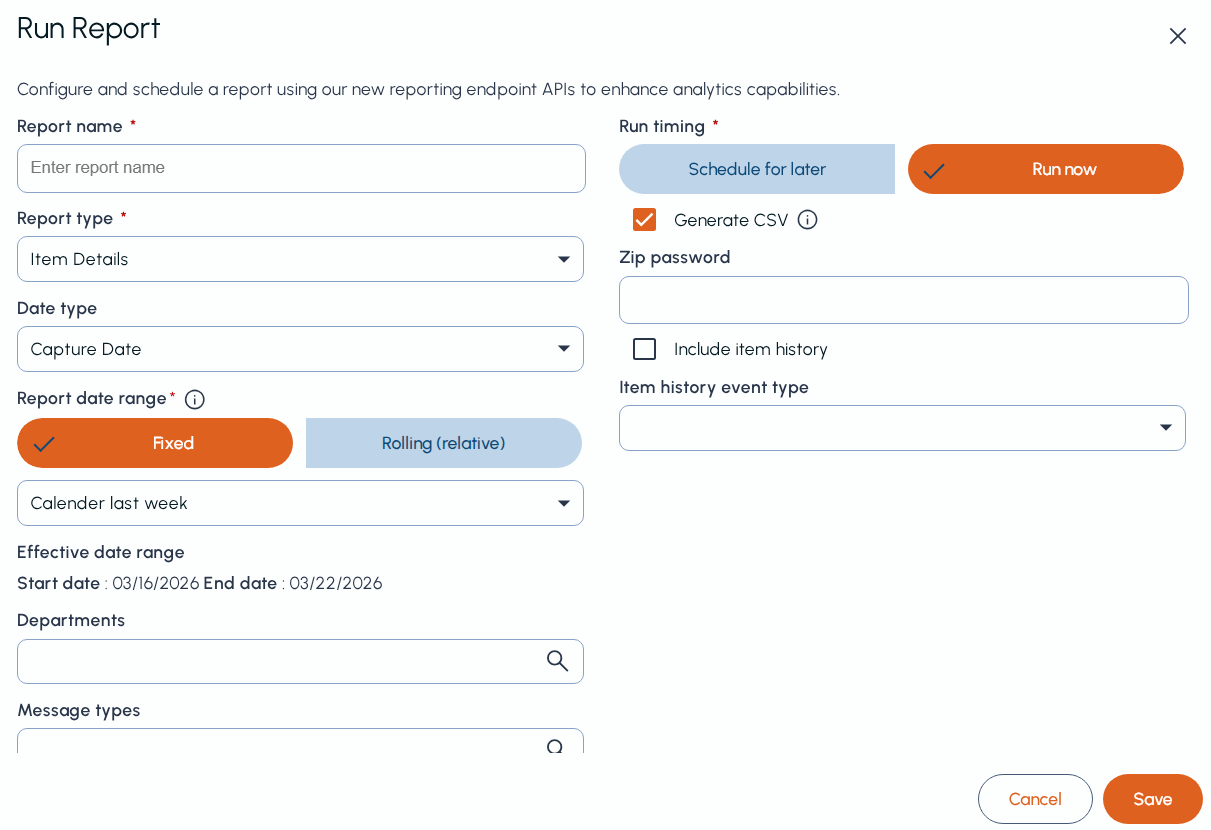
To create a new report, click New Report. The Run Report window is displayed.
-
Provide the following parameters:
-
Report Name
-
Report TypeThe report creation dialog dynamically updates to show the other report filters based on the selected report type.
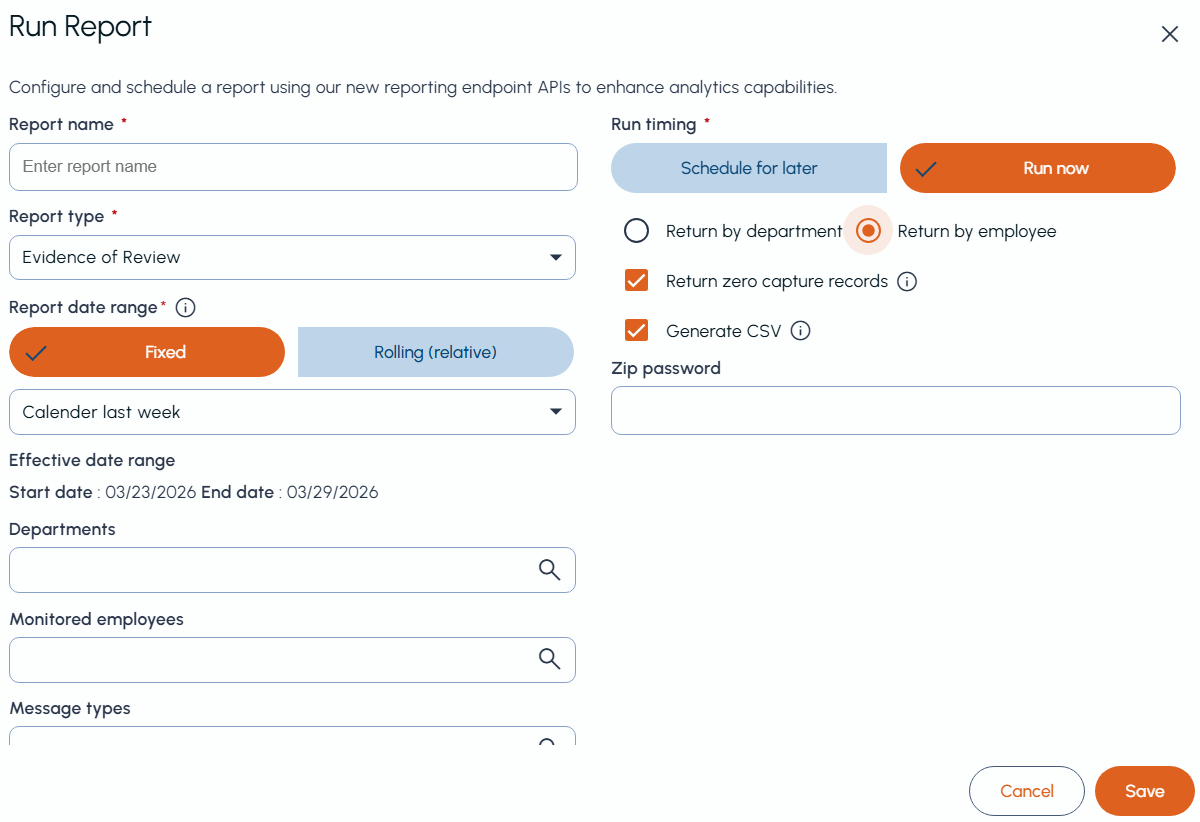 Note: For Item Metrics report type, when the report is generated by department, results are returned only up to the previous day. Results for the current date are not included.
-
Date Type (in case of Item Details report type)
-
Report Date Range
-
Fixed date range
-
Rolling date range
-
-
Departments
-
Message type
-
Monitored employees
-
Message direction
-
Capture types
-
Scopes
-
Users
-
Reviewer activity types (Marks, Escalations, Comments, Appraised, Labels)
-
Assessment activity types (Marks, Escalations, Comments, Appraised, Labels)Note: Reviewer and assessment activity types cannot have overlapping selections.
-
Run Timing
-
Schedule for later i.e. Schedule
-
Run now i.e. Immediate
-
-
-
Select Generate CSV option to export the selected report data as a CSV file.Note: For Item Details, Item Metrics, and Evidence of Review reports generated through Enhanced Reporting - User Interface, the CSV output includes the input parameters used for report generation.
-
Provide a password for the ZIP file to be exported.
-
Click Save.
-
Refresh the report list to view the new report request.
Re-run, Edit and Download Reports
At the end of the report list entry, you can find the following options:
Re-run (Requeue)
-
Available only for Immediate reports and individual executions within Schedule runs.
-
Opens the report creation dialog with pre-filled values.
-
Users can modify report name, and update filter criteria.
-
Report type cannot be changed.
-
Report parameters for Item List and Filter Summary reports cannot be modified in either Requeue or Edit mode.Note: In Item List and Filter Summary reports, filters that were not selected when the original report was generated are displayed as None.
Edit
-
Available only for Schedule reports.
-
Allows updating report name, filter criteria, and can be rescheduled.
-
Past executions remain unchanged; updates apply only to future runs.
Download
-
Expired reports cannot be downloaded.
-
Reports can be downloaded only in CSV format.
-
The UI does not display report data or visualizations.
-
Users can open downloaded CSV files in external analytics tools such as Excel, Power BI, or Tableau.